What does “Stop Wasting Money on the Wrong Marketing Channels” mean for a growing B2B brand?
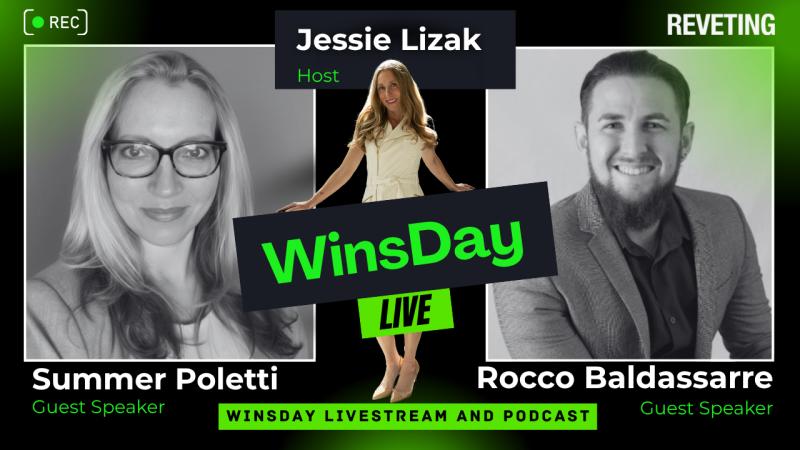
In this episode of the Winsday Podcast, host Jessie Lizak sits down with Summer Poletti, Founder of Rise of Us, and Rocco Baldassarre, Head of Business Development at Shirofune, to unpack what it really takes to build an effective modern marketing strategy. The conversation explores why there is no universal marketing channel that works for every business, how AI is changing advertising and campaign execution, and why companies need to build a go-to-market strategy around their own buyers rather than copying someone else's playbook.
Summer and Rocco also discuss the growing role of advertising inside AI-powered conversations and why AI should accelerate execution without replacing human strategy and experience. They dive into how businesses can use automation and real-time data to improve ROAS, why attribution data is only valuable when teams can act on it quickly, and how operational problems can ultimately undermine marketing performance. Whether you're a marketer, sales leader, founder, or business owner, this episode offers practical insight into making smarter channel decisions, using AI strategically, and getting more from every marketing dollar.
- There Is No Single Best Channel
- Advertising Inside AI-Powered Conversations
- Stop Copying Someone Else's GTM Playbook
- Making Digital Ad Spend Drive ROAS
What the guests said
These are direct excerpts from the episode transcript. Punctuation, capitalization, filler repetitions, and obvious transcription artifacts were lightly cleaned for readability.
“What works? It depends on your stage. It depends on your location. It depends on your industry. It depends on the size of your team, your resources. But more than anything, it depends on your buyer. It depends on your buyer and what they like.”
“When it comes to the channel that you need to pick, most marketers forget the ground rule of marketing is that we are talking to people. Our customers are people. Our leads are people. Sometimes marketers forget about the rule of common sense. They try to overcomplicate something that is very simple.”
Official episode notes
In this episode of the Winsday Podcast, host Jessie Lizak sits down with Summer Poletti, Founder of Rise of Us, and Rocco Baldassarre, Head of Business Development at Shirofune, to unpack what it really takes to build an effective modern marketing strategy. The conversation explores why there is no universal marketing channel that works for every business, how AI is changing advertising and campaign execution, and why companies need to build a go-to-market strategy around their own buyers rather than copying someone else's playbook.
Summer and Rocco also discuss the growing role of advertising inside AI-powered conversations and why AI should accelerate execution without replacing human strategy and experience. They dive into how businesses can use automation and real-time data to improve ROAS, why attribution data is only valuable when teams can act on it quickly, and how operational problems can ultimately undermine marketing performance. Whether you're a marketer, sales leader, founder, or business owner, this episode offers practical insight into making smarter channel decisions, using AI strategically, and getting more from every marketing dollar.
Main Topics Covered
There Is No Single Best Channel
Advertising Inside AI-Powered Conversations
Stop Copying Someone Else's GTM Playbook
Making Digital Ad Spend Drive ROAS
Connect with Summer Poletti
Website: https://www.theriseofus.com
LinkedIn: https://www.linkedin.com/in/summer-poletti-rhymes-with-spaghetti-27207812/
Rise of Us LinkedIn: https://www.linkedin.com/company/rise-of-us/
Connect with Rocco Baldassarre
Website: https://shirofune.io
Shirofune LinkedIn: https://www.linkedin.com/company/shirofune-usa/
Follow Reveting to stay updated on upcoming episodes
Website: https://www.reveting.com/
Connect with Jessie Lizak
How can a livestream establish authority before a sales conversation?
A well-produced livestream lets prospects see how a founder or executive thinks in real time. Viewers can hear the nuance behind an opinion, watch the host respond to guests, and decide whether the people behind the brand understand their world. That kind of evidence is difficult to reproduce with polished claims alone. It is one reason expert-led livestreaming can support trust, demand generation, partnerships, recruiting, and sales at the same time.
Professional livestream production also protects the audience experience. The work includes show planning, guest coordination, run-of-show development, branded scenes, audio and video checks, live moderation, platform distribution, and post-show follow-up. Outsourcing those details allows the host to focus on the conversation while a production partner keeps the broadcast consistent and usable for everything that follows.
How does one episode become a podcast and short-form video library?
The recording is only the starting point. A single WinsDay-style conversation can become a podcast episode, a full YouTube video, several short-form clips, written show notes, quote-led social posts, an email, and internal sales material. The strongest repurposing does not cut random moments simply because they are short. It identifies complete ideas that answer a buyer question, challenge an assumption, or offer a practical next step.
This approach gives a team more value from the time already spent recording. It also creates repetition without duplication: the same core expertise can appear as audio for podcast listeners, video for YouTube viewers, concise clips for social feeds, and written context for people searching on Google or asking an AI tool. Each format supports a different discovery habit while reinforcing the same positioning.
What should brands publish on LinkedIn and YouTube after the show?
LinkedIn and YouTube serve different roles in an expert-led content system. LinkedIn is useful for timely ideas, direct conversation, professional relationships, and distribution through the people attached to a brand. YouTube gives long-form video and searchable clips a longer shelf life. A practical publishing plan uses both: LinkedIn to create dialogue around the episode and YouTube to build a structured library of topics that buyers can discover later.
Instead of posting the same caption everywhere, teams should package the episode around the intent of each platform. A LinkedIn post can frame a strong point of view and invite informed discussion. A YouTube title and description should state the problem, audience, and outcome in plain language. Short clips need an immediate premise, readable captions, and enough context to stand alone. Consistent publishing matters, but clarity matters more.